
Trends move fast, but most teams move in bursts—launch cycles, campaign windows, quarterly planning. This kit turns trend discovery into a repeatable workflow: collect signals, score what matters, validate quickly, and translate insights into clear next steps for products, content, and positioning. The goal isn’t to predict the future perfectly; it’s to make better bets with less noise, using a process that holds up when the feed is chaotic and opinions are loud.
When everyone uses the same criteria, trend conversations shift from “should we chase this?” to “what would make this worth testing, and what would disprove it?” That’s what keeps decision-making grounded—especially when a trend looks popular but doesn’t match your audience’s real willingness to pay.
| Component | Best used for | Output you should expect |
|---|---|---|
| Trend forecast checklist | Keeping research consistent and complete | A filled-out evaluation for each trend candidate |
| Guide/eBook | Learning the system and avoiding common forecasting errors | A repeatable workflow and clearer decision criteria |
| Prompt pack | Speeding up scanning, summarizing, and testing assumptions | Draft briefs, hypotheses, and experiment ideas |
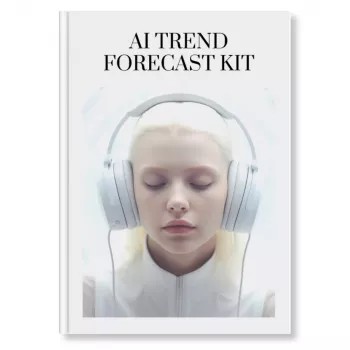
For a ready-to-use system, start with AI Trend Forecast Kit (digital download) and run the workflow once. Even a single cycle creates a baseline you can improve over time.
To keep scanning grounded, it helps to balance “what people say” with “what people do.” Industry research can provide useful context, such as McKinsey Global Institute’s Technology Trends Outlook, while frameworks like the Gartner Hype Cycle can help separate early novelty from durable adoption.
| Criteria | What to look for | Score (1–5) |
|---|---|---|
| Relevance | Direct tie to a known customer job-to-be-done | |
| Timing | Clear growth signals without being fully commoditized | |
| Proof | Multiple independent sources and real-world examples | |
| Defensibility | Unique angle, brand advantage, or proprietary access | |
| Operational fit | Feasible experiments and delivery within constraints |
If a theme scores high on relevance but low on proof, it may be a “monitor or micro-test” candidate rather than a full pivot. If it scores high on proof but low on defensibility, it may still be worth pursuing—just with a sharper angle and clearer differentiation.
Trend work becomes more valuable when it connects to an actual deliverable. For example, a validated theme can guide which digital resources to create next (like structured checklists), what product categories to feature, or how to frame a campaign hook without relying on vague “vibes.” If your audience overlaps with wellness and self-improvement, a structured companion resource like The Body Confidence Kickstart Checklist can support clearer outcomes and messaging tests around motivation, habit shifts, and confidence-driven routines.
For retail and merchandising teams, trend scoring also helps filter aesthetic waves. Instead of reacting to every micro-style, you can test a small drop and measure product page engagement. If a style signal strengthens, items like the Fairy Grunge Lace Patchwork Crop Top can be positioned with clearer naming, styling notes, and content themes that match what customers are actively seeking.
To reduce bias, use at least one neutral, data-oriented source for context. Research summaries like Pew Research Center’s Internet & Technology coverage can help ground assumptions about how people adopt tools and behaviors over time.
It works with common AI chat tools plus basic note-taking or a spreadsheet. The checklist and guide keep the process consistent regardless of which platform you use to collect links, quotes, and observations.
A practical cadence is a weekly light scan, a monthly clustering and scoring session, and quarterly decisions for bigger bets. If your industry moves faster, shorten the cycle; if it moves slower, keep the scan light and focus on stronger validation.
Yes—this is designed to be beginner-friendly with a step-by-step checklist and workflow guidance. Starting with small validation tests helps build confidence without overcommitting time or budget.











Leave a comment